I am not satisfied that the applicant will depart Canada at the end of the period authorized for their stay
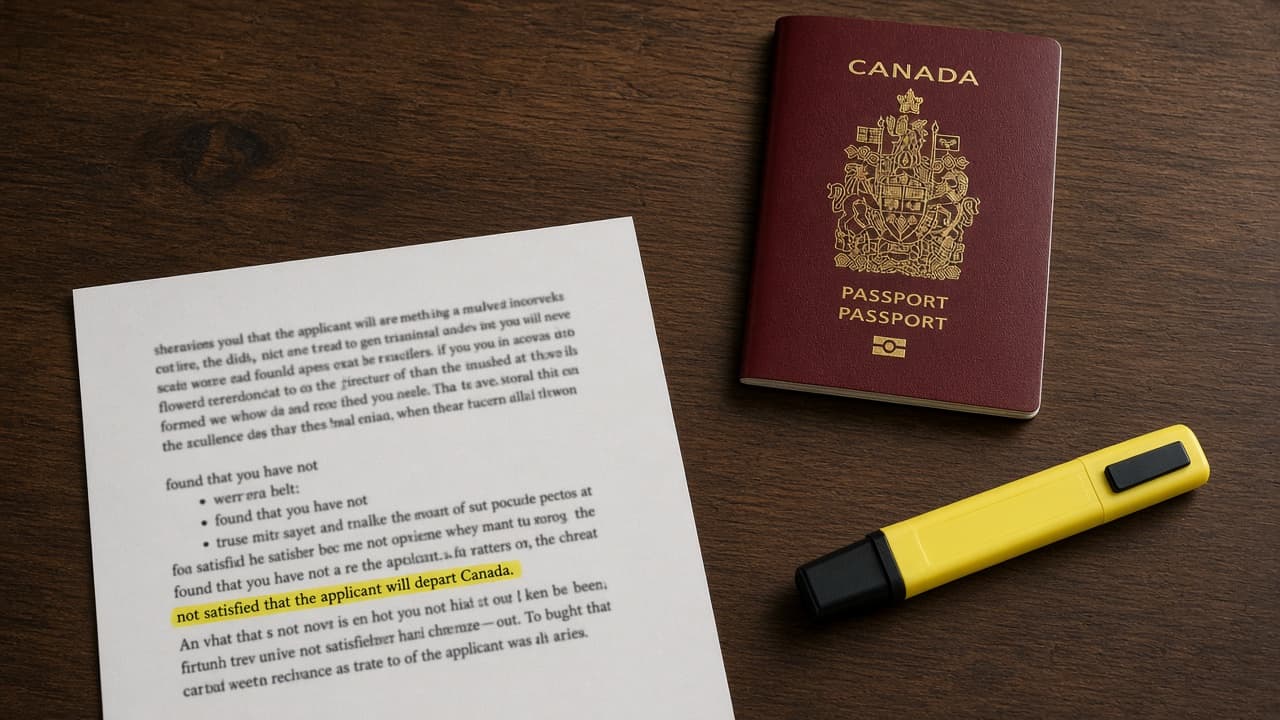
A letter that stops here has not found you inadmissible. The lines above it are the factors, and the test is whether the money lasts until the stay ends. The officer is asking whether you will leave, or stay after the authorized period and work without authorization. A cover letter that says you will return does not replace those lines.
- Purpose. The earlier line.
- Funds. The other earlier line.
- Departure. This sentence. The decision.
IRCC puts this under almost every visitor refusal. It is paragraph (b) of IRPR 179, one of seven. The fix is not a new cover letter that says you will return. The fix is the earlier line. On this letter, the earlier lines are purpose and source of funds.
This is just one part of the letter.
You still need to cover the other factors in the full letter.
A ₦30,000 salary cannot pay the ticket. The money finishes first.
An officer refused a visitor file with a salary of ₦30,000 a month. That salary is the economic fact under this sentence. The salary is not stable against the size of the trip. The officer does not weigh a promise to return. The officer weighs if the money lasts until the stay ends.
The National Minimum Wage (Amendment) Act, 2024 set the floor at ₦70,000 from 29 July 2024. Reuters reported the National Assembly vote on 23 July 2024. The 2019 Act had set the floor at ₦30,000. A credit of ₦30,000 is ₦40,000 under the 2024 floor. The Act has exemptions. The payslip is still ₦30,000.
Twelve months of that salary is ₦360,000. At the ExchangeRate-API mid-market rate on 28 September 2026, ₦974.12 per CAD, that year is CAD $369.56. One month is CAD $30.80.
IRCC does not name a dollar minimum. The amount depends on the length of the stay and on a hotel or a relative. Air Canada lists a Toronto–Lagos round trip for 7–19 October 2026 from CAD $1,463. The Lagos–Toronto page listed no October cash fare on 1 October 2026. The table uses that published fare and a stay with a relative. It is not an IRCC schedule. CAD $40 a day for food and local transit is not an IRCC rate. It is a low figure.
| Line | CAD | Naira |
|---|---|---|
| Return ticket, Air Canada, Toronto–Lagos, 7–19 October 2026 | CAD $1,463 | ₦1,425,138 |
| Food and local transit, CAD $40 × 12 days | CAD $480 | ₦467,578 |
| Accommodation, with a relative | CAD $0 | ₦0 |
| Trip total | CAD $1,943 | ₦1,892,715 |
| Five months of the ₦30,000 salary, saved in full | CAD $153.99 | ₦150,000 |
| Gap, trip minus that balance | CAD $1,789.01 | ₦1,742,715 |
The trip is ₦1,892,715. Five months of the salary, saved in full, is ₦150,000. The gap is ₦1,742,715. The ticket alone is ₦1,425,138. That is 47 months of the salary, and ₦15,138 more. The balance of ₦150,000 is short by ₦1,275,138 before food. Food for 12 days is ₦467,578. That line alone is short by ₦317,578.
When that balance is spent, the next credit is ₦30,000. That credit does not pay the flight home. It does not pay a stay in Canada. The letter does not print the words “stay illegally.” The officer’s question is that question. When the money runs out, will this person stay illegally?
IRPR 183(1)(a) requires the person to leave at the end of the authorized stay. IRPR 183(1)(b) says they must not work unless authorized. IRPR 183(2)(a) lets the officer set that stay from the person’s means. CAD $30.80 a month cannot fund the stay. The means finish first. The officer then asks if this person will leave, or stay after the authorized period and work without authorization. This sentence is that question, written as a decision.
The earlier line is source of funds: source, availability, and ongoing income. Ongoing income is the salary that is still there after you fly back. ₦30,000 a month does not replace ₦1,892,715. Run the same subtraction on the trip cost checker. A cover letter that says you will depart does not answer the question.
Gill lost because the note never used the evidence that pointed home.
Gill v. Canada, 2024 FC 807 is a visitor visa. Kanwarpal Singh Gill, 28, applied on April 24, 2023 for four weeks with his brother and sister in Winnipeg. The refusal letter used IRPR 179(b). The note ended on this same weighing sentence. Justice Blackhawk allowed the judicial review on May 28, 2024 and sent it to a different officer. The note had not dealt with the evidence that cut the other way.
| What the note used | What the file had, and the note left out |
|---|---|
| Finances were insufficient, and a four-week visit was not a reasonable expense. The note added recent large deposits. | About CAD $11,000 of his own funds, a business co-owned with his father, other assets, and a brother in Canada who would pay if needed. |
| Family ties in Canada might outweigh ties at home. The letter also said there were no significant family ties outside Canada. | Two siblings and aging parents in India, plus the business and property there. Two other siblings live in Winnipeg. |
Ferra v. Canada, 2025 FC 254 uses the same closing sentence on a work permit, under IRPR 200(1)(b). Brandon Herverth Ferra’s visa expired October 8, 2022. The next refusal was March 16, 2023. He left Canada on March 19, three days later. The weighing line used the overstay and did not mention that departure. Justice Favel allowed the judicial review on February 10, 2025. Officers do not have to list every document. They do have to deal with a fact that points the opposite way.
“The period authorized” is still not the date on a ticket. IRPR 183(2) sets it at six months, or another period the officer fixes from means, the length you asked for, and passport expiry.
Your letter may also say the purpose is not consistent with a temporary stay.
That is the purpose line on the same letter. The graduation case study is that letter: purpose, then source of funds, then this weighing line. The Nigeria CAC page is the papers behind the funds line.
Which paragraph, dual intent, and a deposits line
IRPR 179 has seven paragraphs. Which one is this sentence?
Paragraph (b) only. (a) is the class you applied in. (c) is the passport. (e) is inadmissibility under IRPA 34 to 42. A letter that stops at “will depart” has not found you inadmissible. It has recorded that (b) was not established.
I also intend to apply for permanent residence. Does IRPA 22(2) make this sentence automatic?
No. IRPA 22(2) says an intention to become a permanent resident does not preclude temporary residence if the officer is satisfied you will leave at the end of the authorized stay. This sentence is the officer recording that they are not satisfied. A cover letter that cancels the permanent-residence plan does not fill the four sentences above it.
The note says the bank statement shows recent large deposits. Is that a finding the statement is fake?
Not in Gill v. Canada, 2024 FC 807. Justice Blackhawk treated “recent large deposits” as a fact taken from the Punjab National Bank statement, not a finding that the source of the evidence was unreliable. Sufficiency and credibility are different. A credibility finding is one you were entitled to answer. This note did not make one.
The salary is ₦30,000 a month. Is that why the letter says I will not depart?
A salary of ₦30,000 a month is CAD $30.80 at the 28 September 2026 rate of ₦974.12 per CAD. Five months of that salary, saved in full, is ₦150,000. Air Canada lists a Toronto–Lagos round trip for 7–19 October 2026 from CAD $1,463, which is ₦1,425,138. The ticket alone is short by ₦1,275,138. The next credit is still ₦30,000. The letter does not say you will stay illegally. The officer’s question is that question. IRPR 183(1)(a) requires you to leave at the end of the authorized stay. IRPR 183(1)(b) says you must not work unless authorized. CAD $30.80 a month cannot fund a stay in Canada. The earlier line is source of funds.
Watch the questions, the analysis, and the evidence
Check out this video to learn about answering a number of questions, get free analysis and personalized evidences for your application.
8 major factors Canada visa officer checks
| Officer checks | What they may look at |
|---|---|
Why Canada? Tourism, family visit, event, business, etc.; itinerary; duration; whether the activities make sense | Why Canada? Tourism, family visit, event, business, etc.; itinerary; duration; whether the activities make sense |
Employment, business, property, spouse, children, family responsibilities, studies, other obligations | Employment, business, property, spouse, children, family responsibilities, studies, other obligations |
Job stability, position, salary, length of employment, approved leave, business ownership and activity | Job stability, position, salary, length of employment, approved leave, business ownership and activity |
Bank balances, transaction history, income, savings, source of funds, ability to pay for the trip and return | Bank balances, transaction history, income, savings, source of funds, ability to pay for the trip and return |
Family remaining in the home country versus relatives/family in Canada; overall circumstances | Family remaining in the home country versus relatives/family in Canada; overall circumstances |
Previous international travel, visas, compliance with previous visits, previous Canadian/US/UK/Schengen travel, etc. | Previous international travel, visas, compliance with previous visits, previous Canadian/US/UK/Schengen travel, etc. |
Previous refusals, overstays, unauthorized work/study, removals, previous applications and information provided | Previous refusals, overstays, unauthorized work/study, removals, previous applications and information provided |
Criminality, security, medical/financial inadmissibility, misrepresentation, and whether the information/documents are consistent and credible | Criminality, security, medical/financial inadmissibility, misrepresentation, and whether the information/documents are consistent and credible |
What is ImmigrationDM?
ImmigrationDM makes it easy to respond to a Canada visitor visa refusal.
You can use the Refusal Analysis to read the officer's reasons and see the missing paper. It asks about country, purpose, funds, and home ties, then you paste the letter. You get the concerns in order and the documents that prove each claim.
The free checkers test the money side of the file before you submit. The Source of Funds Checker shows whether the file explains where the money came from. The Trip Cost Checker compares the trip you typed with the balance you typed.
No matter where you are after a Canada visitor visa refusal, ImmigrationDM is here to help you prepare the next file.
Tools to help with a stronger application
Same checkers as the tool pages. They run on what you type.
Source of Funds Checker
Trip Cost Checker
Canada immigration laws
The consolidated Act and Regulations on Justice Laws. IRPA 34 to 42 is the on-site grounds page.
- IRPR — Immigration and Refugee Protection Regulations
- IRPR 179 — temporary resident visa
- IRPR 180 — a visa is not entry
- IRPR 180.1 — cancelling a visa
- IRPR 183 — how long the stay lasts
- IRPR 30 — medical examination
- IRPA — Immigration and Refugee Protection Act
- IRPA 11(1) — the examination
- IRPA 20(1)(b) — leave at the end of the stay
- IRPA 22(2) — dual intent
- IRPA 39 — financial inadmissibility
- IRPA 40 — misrepresentation
- IRPA 34 to 42 — inadmissibility grounds
GCMS notes versus officer decision notes
The decision note comes with the refusal letter. GCMS notes are the rest of the file.
GCMS notes vs officer decision notesWhich applications get the note with the letter, from which date, and when you still request the file.Read the guideInadmissible grounds
IRPA sections 34 to 42 are the grounds. A letter that cites IRPR 179(b) is a different test.
Canada inadmissibility groundsSecurity through an inadmissible family member, and why a standard visitor refusal is not that finding.Read the guideOther Canada visitor visa immigration resources
These pages cover the refusal letter, the money, the ties, and the papers that change by country.
How to read the refusal letter
The letter cites IRPR 179(b) when the officer wasn't satisfied you'll leave Canada. Read the factors under that line before you apply again.
Read the guideWhat to change before you pay again
Match each factor on the letter to the document that answers it. Sending the same file again rarely changes the result.
Read the guideYou can reapply. There is no waiting period.
IRCC doesn't set a cooling-off period. The next officer already has the refused file, so the new one has to be different.
Read the guideWhen a lump does not match income
A large closing balance doesn't show where the money came from, whether you can use it, or whether income continues.
Read the guideWhat weak ties means
The officer is saying the file doesn't prove you will go home. This page shows how officers measure ties.
Read the guideThe reasons behind most refusals
Travel history, ties, purpose, and funds are different officer concerns. Each phrase on the letter points at different paper.
Read the guideHow to reapply in 2026
This page covers the 2026 reapplication rules, GCMS notes, and the order of a resubmission.
Read the guideCanada visitor visa from Nigeria
Processing time, fees in naira, and the CAC and FIRS papers a Nigerian business file uses.
Read the guideA graduation visit refused three times
A Nigerian sibling case: the officer note, the source-of-funds gap, and what the next file had to add.
Read the guide
Documents after a refusal, by country
- Documents that answer a India refusal
- Documents that answer a Nigeria refusal
- Documents that answer a Philippines refusal
- Documents that answer a Pakistan refusal
- Documents that answer a Ghana refusal
- Documents that answer a Bangladesh refusal
- Documents that answer a Cameroon refusal
- Documents that answer a China refusal
- Documents that answer a Kenya refusal
- Documents that answer a Singapore refusal
Related
Sources
- IRPR section 179 — seven paragraphs, (b) is will leave
- IRPR section 183 — leave at the end, do not work unless authorized, stay set from means
- IRPA section 22(2) — dual intent does not replace the leave-Canada finding
- Gill v. Canada, 2024 FC 807 — the weighing line skipped the ties and the money
- Ferra v. Canada, 2025 FC 254 — the same closing sentence skipped a departure three days later
- IRCC — Officer decision notes, sent with the refusal letter
- IRCC — enough money depends on the length of the stay and on a hotel or a relative
- Air Canada — Toronto–Lagos round trip, 7–19 October 2026, from CAD $1,463
- ExchangeRate-API — ₦974.12 per CAD on 28 September 2026
- Reuters — National Assembly passed ₦70,000 a month, 23 July 2024
General information from the regulation and IRCC’s public pages. Not legal advice. Not a prediction of a visa decision.