Canada Visitor Visa from Nigeria (2026)
Naira fees, CAC & FIRS documents, IRCC’s 47-day processing time, and what officers look for in Nigerian visitor files.

Apply 5–6 months before travel. A TRV approval does not guarantee entry: a CBSA officer at the port of entry can stamp a shorter stay than your visa shows — say the same story you filed.
Nigeria sends one of the largest volumes of Canada visitor visa applications from West Africa — and sits in IRCC's higher-scrutiny band in Open Data. In 2026 that combination matters: Canada is reducing temporary resident intake under the 2025–2027 Levels Plan, officers are under explicit pressure to favour clear, credible, complete files over borderline ones, and a high balance on a Zenith or GTBank statement without a source-of-funds story still fails every week.
This guide is for first-time and returning Nigerian applicants planning tourism, family visits, conferences, or short business meetings — not work or study. If you were already refused, start with our 2026 reapplication playbook, top refusal reasons, and the real Nigerian sibling refusal case study.
Abbreviations & terms
- TRV — Temporary resident visa (visitor visa stamp in passport)
- IRCC — Immigration, Refugees and Citizenship Canada
- CBSA — Canada Border Services Agency (port-of-entry officers)
- IRPR 179 — Regulation setting visitor visa requirements, including departure intent
- CAC — Corporate Affairs Commission (Nigeria business registration)
- FIRS — Federal Inland Revenue Service (Nigeria tax authority)
- TCC — Tax Clearance Certificate (FIRS)
- VAC — Visa application centre — in Nigeria, VFS Global runs Canada centres in Lagos (Lekki) and Abuja only
- CAD — Canadian dollars
- NGN — Nigerian naira
High volume, higher scrutiny — what changed for Nigeria
Four shifts shape Nigerian TRV files in 2026 — three from federal policy, one from how Nigeria files are actually read at the visa office.
- 01Lower temporary resident targetsThe supplementary 2025–2027 Immigration Levels Plan brings planned temporary resident levels down from the post-pandemic peak. More competition per credible file — not a guarantee of refusal, but less margin for thin applications.
- 02Stronger officer powers on TR documentsRegulatory amendments in force from January 31, 2025 let officers cancel temporary resident documents when facts no longer match the file, the holder is inadmissible, or the document was issued in error. A visa stamp is not a free pass to behave differently from what you declared.
- 03Integrity, volume, and selectivityMinisterial messaging through 2025–2026 has been consistent: crack down on misuse, reduce temporary resident numbers, and approve files that clearly meet the test — not borderline ones talked into yes. Put am simply: Canada wan bring temporary visitor numbers down, and officer dem no dey carry last for borderline files again.
- 04Nigeria: high volume plus high scrutinyIRCC Open Data has long put Nigeria in a lower approval band than many Western source countries — often alongside other high-refusal West African and South Asian markets. Plenty application dey comot from here, and scrutiny dey high: na the combo wey make weak files chop refusal quick. E no mean say dem must refuse you; e mean dem go look your file well well until your papers answer the question dem never ask yet. Quality applicants treat the file like an audit: every naira in the account get paper trail, every day in Canada get name and address, every tie at home get document number for exhibit index — no be to drop big balance and hope.
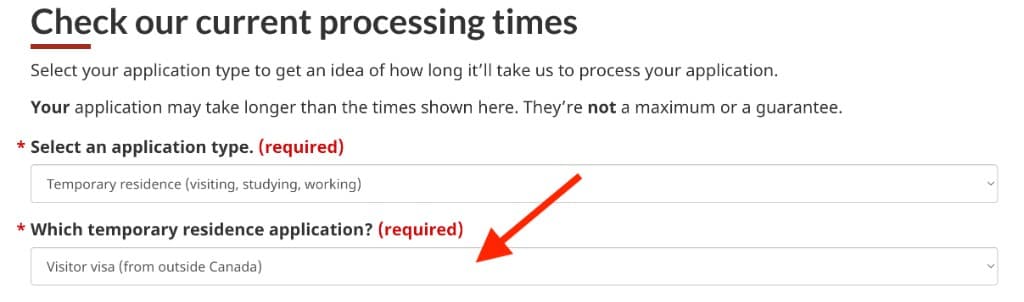
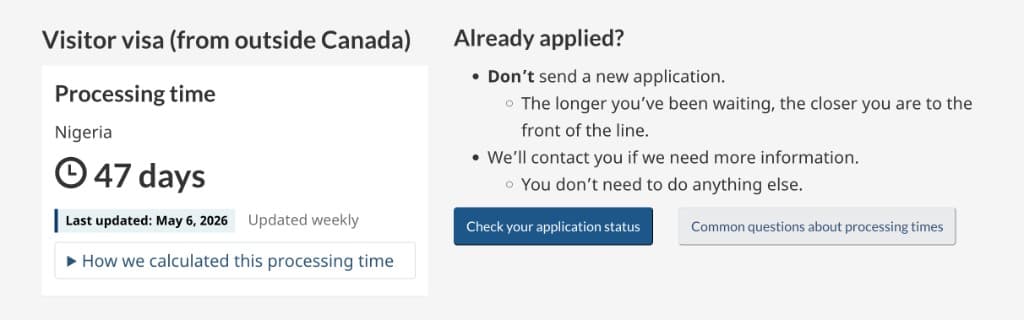
Visitor visa (from outside Canada) — Nigeria: 47 days
As of May 13, 2026, IRCC's processing-time tool reports 47 days for Visitor visa (from outside Canada) when the country of application is Nigeria. The figure is updated weekly and is an estimate — not a promise your file will be decided in exactly 47 days. Always pull the live number before you plan.
Apply 5–6 months ahead. Forty-seven days is not “apply in November for December.” Add biometrics scheduling at the VFS centre in Lagos (Purplelekki, Lekki Phase 1) or Abuja — the only two Canada VAC cities in Nigeria — plus possible document requests, passport courier time, and your own document-gathering window for CAC extracts and FIRS tax clearance. For travel in Q4 2026, a realistic submission window is Q2 2026 — not eight weeks before departure.
| Milestone | When | Detail |
|---|---|---|
| Target travel month | Month 0 (your trip) | Example: December 2026 family visit or conference. |
| Apply window opens | 5–6 months before travel | Start document gathering and portal submission around June–July 2026 for a December trip — not six weeks before. |
| IRCC processing (Nigeria) | ~47 days published | IRCC’s tool shows 47 days for Visitor visa (from outside Canada) → Nigeria (last updated May 13, 2026; updated weekly). Add buffer for VAC biometrics and document requests. |
| Passport request & travel | If approved | If IRCC approves, submit your passport when instructed (often through VFS). Plan non-refundable flights only after you hold the visa vignette. |
| Port of entry | Arrival in Canada | CBSA may stamp a stay shorter than your visa validity — e.g. two weeks even if the application contemplated six months. |
Six months on the visa ≠ six months in Canada
Many Nigerian applicants assume that if IRCC approves a six-month multiple-entry visa, they may remain for six months on the first trip. That is not guaranteed. At the airport or land border, a CBSA officer examines your passport, asks about purpose and funds, and stamps an authorized stay — often noted as a date in your passport or on a visitor record. They may authorize two weeks for a wedding weekend even when your application described a six-week family visit, if your answers at the counter do not align with the file or your return plans sound vague.
Practical takeaway: match your Letter of Explanation, itinerary, and invitation to the trip you will actually take at the counter. Overstaying the stamped date — even by a few days — can jeopardize future visas and, under 2025 rules, temporary resident document status. Fly with printed copies of your port-of-entry letter of introduction (if issued), invitation, and return flight — only after a positive decision.
What Canada charges — and what that is in naira (May 19, 2026)
IRCC fees are charged in Canadian dollars. For planning in Nigeria we use the Wise mid-market rate on May 19, 2026: ₦999 per CAD. Parallel-market (“black market”) rates are often higher — budget 3–5% above mid-market if you are buying CAD cash in Lagos or Abuja.
| Fee item | CAD | NGN (₦999/CAD) | Note |
|---|---|---|---|
| Visitor visa application (single or multiple entry) | $100 | ₦99,900 | Per person (CAN$500 cap for families of 5+ applying together). Not refunded if refused. |
| Biometrics (when required) | $85 | ₦84,915 | Often valid up to 10 years if already given — confirm in your IRCC account. |
| GCMS notes (optional, after a refusal) | $5 | ₦4,995 | ATIP request; filed through a Canadian resident or citizen if you are outside Canada. |
| Typical first-time total | $185 | ₦184,815 | Visa + biometrics; excludes trip funds, VAC service charges, courier. |
Trip funds are separate from government fees. Officers assess whether you can afford the visit — flights, hotels, spending money, insurance — not whether you can afford the application fee. Showing ₦15 million in an account without salary slips, CAC, or tax filings that explain deposits is weaker than showing ₦3 million with a clean twelve-month trail.
Nigeria-specific documents IRCC expects to see
There is no separate “Nigeria checklist” published by IRCC — the portal generates a personalised list. In practice, Nigerian salaried and self-employed files diverge sharply. Use the table below as a quality bar, not a minimum dump list.
| Category | Salaried (Lagos, Abuja, PH, etc.) | Self-employed / business owner | Why it matters |
|---|---|---|---|
| Identity & forms | Valid passport, IMM5257, IMM5645 (family info), digital photo per IRCC spec. | Same as salaried. | Inconsistencies between forms and uploads are an automatic credibility hit. |
| Business registration | Usually N/A unless you also run a side business funding the trip. | CAC certificate (incorporation or business name registration), MEMART if company, status report if requested. | Officers treat “I own a business” without CAC as an unsupported claim — common refusal driver for Nigeria files. |
| Tax compliance | PAYE evidence: employer letter, recent payslips, FIRS tax ID, personal tax filings or annual returns where applicable. | FIRS Tax Clearance Certificate (TCC) for recent years, company tax filings, VAT/WHT where relevant. | Tax clearance shows declared income matches bank deposits — the audit trail officers want. |
| Funds | 6+ months personal salary account statements (bank letterhead PDF, not screenshots); explain any large deposits. | 12–24 months business account statements; annotate top deposits to invoices; chartered accountant letter dated within 30 days. | Nigeria SMEs often deposit lump sums — short windows hide the pattern officers need to see. |
| Employment / operations | Employer letter on letterhead: role, salary, start date, approved leave for trip dates, contact person. | Client invoices, contracts, utility bills for business premises, staff payroll if applicable. | Proves you have a reason to return after a short visit. |
| Ties to Nigeria | Property deed or long lease, dependants (marriage/birth certificates), ongoing obligations (school fees, loans). | Same, plus active business operations — do not leave the business “paused” in the narrative. | Weak ties is among the most frequent IRPR 179(b) refusal themes in Nigerian TRV refusals — see our ties matrix guide. |
| Purpose of visit | Invitation letter + host status in Canada, itinerary with exact dates, event tickets or conference registration. | Same — purpose must be third-party verifiable, not “tourism” with no structure. | Generic purpose (“visit Canada”) fails in a high-scrutiny market; specificity wins. |
For ties, use a one-page matrix (category, evidence, why you return, exhibit number) — our weak ties fix guide includes a copy-ready structure. NYSC discharge or exemption certificates help recent graduates show structured obligations at home. Marriage certificates and children's birth certificates matter when dependants stay in Nigeria.
Do not use fake documents or hide the truth
A strong Nigerian TRV file is built from real evidence — not bought templates, borrowed balances, or stories that do not match your forms. Under the Immigration and Refugee Protection Act, section 40, misrepresentation includes false information, altered documents, or leaving out facts IRCC would consider material — even if an agent, “consultant,” or friend told you everyone does it.
What counts as misrepresentation (examples)
- Forged or backdated employer letters, CAC extracts, FIRS tax clearance, or bank statements
- Salary paid in for a week then withdrawn to inflate your balance (“show money”)
- False travel history, marital status, employment, or purpose on IMM5257 / IMM5645
- Hiding a prior Canada or other-country visa refusal, removal, or overstay
- Invitation letters or event registrations you know are not genuine
- Letting someone else submit under your name or biometrics without your knowledge
Consequences are severe and long-lasting. IRCC may refuse the application, impose a five-year ban on returning to Canada (from the date of a final misrepresentation finding), keep a permanent fraud flag on your record for future applications, and in serious cases refer the file for investigation or criminal charges. You remain responsible for everything in the portal — including uploads prepared by a third party. A normal refusal under IRPR 179 is difficult enough; a misrepresentation finding is a different category of problem and usually needs a lawyer or RCIC before you apply again.
Official overview: Consequences of immigration and citizenship fraud (Canada.ca).
What “quality applicant” means in 2026
Under IRPR 179, officers must be satisfied you will leave Canada by the end of your authorized stay, meet visitor-class requirements, and have funds for your purpose. A strong Nigerian file makes each element easier for an officer to assess — it does not guarantee approval:
- Purpose: Named event, host, and dates — wedding invitation with venue, conference registration, university registrar letter — not “tourism” with no itinerary.
- Funds: Income history matches deposits; business owners show CAC + FIRS TCC + invoices matching the largest credits in the statement window.
- Ties: At least three categories documented (employment/business, property/family, financial/ongoing obligations) with exhibit numbers in the cover letter.
- Consistency: IMM5257, LoE, invitation, and bank dates tell the same story — contradictions trigger refusals faster in high-scrutiny markets.
- Curated volume: Twenty strong pages beat two hundred random PDFs. Officers have limited time; lead with the answer, then the proof.
Application steps — from Lagos or Abuja (better odds, not a guarantee)
No checklist guarantees a yes from IRCC — Nigeria's approval band in Open Data makes that impossible to promise. These steps are what raise the probability of a clean read: complete file, honest forms, fast response to document requests. A refusal is still possible even when you do everything below; step 05 is part of the realistic path, not a failure mode you can ignore.
- 015–6 months before travelPull live processing times on canada.ca: choose Visit → Visitor visa (from outside Canada) → Nigeria. Screenshot the result the day you plan. Build your document pack (CAC, FIRS, statements, ties) before touching the portal.
- 02Week 1Create or reuse your IRCC account via Apply for a visitor visa. Complete IMM5257 and IMM5645 honestly — prior refusals, prior applications, and travel history must match what IRCC already has on file.
- 03Week 1–2Draft a 1–2 page Letter of Explanation: specific purpose, exact dates, who pays, and a ties summary pointing to exhibit numbers. Upload a curated PDF bundle — bank letterhead statements, CAC, tax clearance, employment or business evidence — not a folder dump.
- 04During & after submissionPay IRCC fees when the portal prompts you during submission — typically ₦99,900 for the application and ₦84,915 for biometrics at mid-market ₦999/CAD (confirm on the live fee list). VAC service charges are separate. After you submit, book biometrics at the VFS centre in Lagos or Abuja only when the instruction letter arrives. Respond to any document request on time — silence reads as abandonment. A decision can still be refused.
- 05If refusedOrder GCMS notes (CAD $5 / ₦4,995) before reapplying. Read our 2026 reapplication playbook and top refusal reasons. Do not resubmit the same file.
Paste your IRCC refusal letter. Get a ranked analysis of why IRCC refused you and what you must fix.
Upload or paste your refusal letter. Get a free preview of the key issues. Then unlock a 1–2 page ranked analysis for a Nigeria visitor-visa refusal.
- Ranked list of the refusal reasons from your letter.
- What the officer needs to see for each reason.
- The documents you must prepare this week.
- 1–2 page personalized analysis. $69 CAD. One-time. No subscription.
Frequently asked questions — Nigeria visitor visa 2026
How long does a Canada visitor visa take from Nigeria in 2026?
IRCC's processing-time tool lists 47 days for Visitor visa (from outside Canada) with country Nigeria — last updated May 13, 2026, refreshed weekly. That is an estimate, not a deadline IRCC owes you. Add buffer for document requests; see the processing section above for biometrics and VAC booking. Refusal is still possible after a long wait.
How much is the Canada tourist visa fee in naira?
At the Wise mid-market rate on May 19, 2026 (₦999 per CAD), the visitor visa application fee of CAD $100 is about ₦99,900 and biometrics of CAD $85 is about ₦84,915 — roughly ₦184,815 combined for a first-time applicant who must give biometrics. Black-market rates run higher; budget a buffer if you are buying CAD cash in Nigeria.
Do I need CAC and tax clearance for a Canada visitor visa from Nigeria?
Salaried employees: employer letter, payslips, and personal bank statements are usually enough — CAC is for business owners. Self-employed applicants and anyone funding the trip from business income should include CAC registration and FIRS tax clearance (TCC) plus 12–24 months of business bank statements. Without that trail, a large account balance often reads as unexplained funds.
Can I get six months in Canada if my visa says six months?
Not automatically. IRCC may approve a visa valid up to six months (or longer for multiple-entry cases), but a CBSA officer at the port of entry decides how long you may actually stay and stamps your passport accordingly. They can authorize as little as two weeks if your story, funds, or return plans do not align with a longer stay — even when your application requested six months.
When should Nigerians apply for a Canada tourist visa in 2026?
Plan 5–6 months before travel. Applying six weeks before Christmas or summer travel is how files get rushed, thin, or refused. Start document gathering early; submit when the pack is audit-ready, not when panic sets in.
Why are Nigeria Canada visitor visa applications scrutinised more in 2026?
Canada reduced temporary resident targets in the 2025–2027 Levels Plan and tightened integrity messaging. Nigeria is both high-volume and in IRCC's higher-refusal band in Open Data — officers see many applications and many weak files. Quality means verifiable purpose, organic funds with source documents, and strong ties — not a high balance alone.
What funds should I show for a short tourist trip?
There is no published Naira or CAD minimum on canada.ca. Officers look at whether your funds match the trip: flights, accommodation, spending money, and ability to cover emergencies, relative to your income history. Some applicants plan around CAD $3,000–$5,000 for a two-week visit as a rough band — not an IRCC rule. Unexplained lump sums fail even when the total looks large.
Where do I give biometrics in Nigeria?
Lagos VAC relocation
Canada's Lagos centre is at Purplelekki, Lekki Phase 1 — not older Ikeja or Victoria Island listings. Confirm the address on VFS important information and your biometrics letter before you travel.
Canada VAC
Lagos
Use Purplelekki, Lekki Phase 1 only — see VFS Lagos VAC relocation notice for current details.
Monday to Friday: 08:00–17:00
Biometrics & passport services when IRCC instructs you
Canada VAC
Abuja
Monday to Friday: 08:00–17:00
Biometrics & passport services when IRCC instructs you
Match your biometrics letter, visa.vfsglobal.com/nga/en/can, and VFS important information when you book. No Canada VAC in Port Harcourt, Kano, or other cities.
Book only after IRCC sends a biometrics instruction letter — current Lagos and Abuja addresses, hours, and VFS links are in the callout below.
Government sources
IRCC and CBSA primary pages — exchange rate illustrations use Wise mid-market on May 19, 2026 (₦999/CAD) for convenience only.
- Canada.ca — Apply for a visitor visa
- Canada.ca — Check IRCC processing times
- IRCC Portal — sign in
- IRCC — Citizenship and immigration application fees (fee list)
- Canada.ca — Biometrics collection and validity
- Canada.ca — Visit Canada eligibility
- IRPR section 179 — temporary resident visa
- Government of Canada — 2025–2027 Immigration Levels Plan (supplementary notice)
- IRCC Open Data — TRV applications and outcomes
- CBSA — Entering Canada (visitor information)
- VFS Global — Canada visa application centres in Nigeria (Lagos & Abuja)
- Canada.ca — Consequences of immigration fraud and misrepresentation
- Immigration and Refugee Protection Act — section 40 (misrepresentation)
Written by Immigration DM editorial using IRCC processing-time data (Nigeria, May 13, 2026), the 2025–2027 Levels Plan, IRPR 179, and patterns from Nigerian visitor visa refusals and GCMS notes. General information only — not legal advice. For misrepresentation, inadmissibility, or repeat refusals, consult a Regulated Canadian Immigration Consultant (RCIC) or immigration lawyer.