My Sister's Canada Visitor Visa Keeps Getting Denied for My Graduation: A Real 3-Refusal Nigerian Case Study (2026)
If you keep applying to bring your sister to your Canadian graduation and IRCC keeps refusing, the issue is almost never the size of her bank balance — it is that the officer cannot trace where the money came from and cannot bind the trip to a specific, third-party-verified graduation event. The fix is two documents: a 24-month business audit trail (CAC, FIRS, statements, accountant letter, matched invoices) and a registrar-issued convocation letter with a 10-day itinerary bracketing the September 2026 ceremony.
This is a real third-refusal case study from Nigeria — once refused in 2025, twice in 2026, with convocation in September 2026. We changed names and file numbers to protect privacy; the officer's wording below matches GCMS with only those edits. We walk through what they wrote, why the same two problems kept showing up, and the exact Immigration DM Immigration DM pack that rebuilds it for a fourth — and ideally final — submission.
For the broader playbook, the companion guides in this cluster are How to reapply for a Canada visitor visa in 2026, the 8 most common TRV refusal reasons, and the weak-ties fix guide.
Abbreviations & terms
- ATIPAccess to Information and Privacy
- CACCorporate Affairs Commission (Nigeria)
- CADCanadian dollars
- FIRSFederal Inland Revenue Service (Nigeria)
- GCMSGlobal Case Management System
- IMM 5292 / IMM 5688Confirmation of Permanent Residence document forms
- IRCCImmigration, Refugees and Citizenship Canada
- IRPAImmigration and Refugee Protection Act
- IRPR 179Immigration and Refugee Protection Regulations, s. 179 (TRV criteria)
- PGWPPost-Graduation Work Permit
- PRPermanent residence / permanent resident
- RCICRegulated Canadian Immigration Consultant
- SMESmall and medium-sized enterprise
- TRVTemporary Resident Visa
- UCIUnique Client Identifier
- VACVisa Application Centre
The basics: sister in Nigeria, brother graduating in Canada
- Country of residence
Nigeria
- Relationship
Sister of host
- Purpose
Attend host's university convocation
- Convocation date
September 2026
- Refusals to date
3 (one in 2025, two in 2026)
- Status
Still applying
- What GCMS stressed
Source of funds + purpose of visit
- Refusal coded as
IRPR 179 — 179(b) departure (funds/purpose support)
What the officer wrote on the third refusal
Same wording as in GCMS; only names and file numbers are edited out. You'll see this shape of text a lot on sibling-to-graduation refusals from Nigeria when money and trip purpose both look thin.
I have reviewed the application. The purpose of the applicant's visit to Canada is not consistent with a temporary stay given the details provided in the application. While I note that the bank statement on file indicates large balance, there is insufficient evidence of the source of funds. Noted limited verifiable evidence of the business income. Given the lack of documents that would substantiate the large deposits, on balance, I am not satisfied that the applicant has access to sufficient funds to support the stated purpose of travel. Weighing the factors in this application, I am not satisfied that the applicant will depart Canada at the end of the period authorized for their stay. For the reasons above, I have refused this application.
What each sentence in the note actually means
“The purpose of the applicant's visit to Canada is not consistent with a temporary stay given the details provided in the application.”
In cases like this, officers often mean: I cannot tell from this file what trip is actually being taken — e.g. no registrar-issued graduation confirmation, no convocation guest pass tied to the ceremony, no day-by-day itinerary. The trip reads as generic and open-ended.
“While I note that the bank statement on file indicates large balance, there is insufficient evidence of the source of funds.”
The single largest signal in the file is the bank balance — and it has no story. A lump sum sitting in an account is a flag, not a tie. The officer wants to see how the money got there: salary deposits, business income, recurring transfers — not a stand-alone closing balance.
“Noted limited verifiable evidence of the business income.”
If the applicant is self-employed, the file did not include the documents that prove a business actually operates: registration, tax filings, invoices to named customers, recurring deposits matching invoices. The officer is saying: I see the claim, I do not see the audit trail.
“Given the lack of documents that would substantiate the large deposits, on balance, I am not satisfied that the applicant has access to sufficient funds to support the stated purpose of travel.”
This sentence is the officer's means finding (credible funds for the trip), not the statutory wording of IRPR 179(b). Even with a large balance, unexplained money rarely carries the file: if deposits are not substantiated, the balance reads as show money. That weakness is then weighed with everything else toward IRPR 179(b) (will depart) and 179(d) (meets visitor-class requirements).
“I am not satisfied that the applicant will depart Canada at the end of the period authorized for their stay.”
The closing line — this is IRPR 179(b) verbatim (will leave Canada by the end of the authorized stay). When purpose and funds are weak, officers often reach this negative 179(b) conclusion; refusal letters usually spotlight (b) even when the note also discusses finances.
What went in vs what actually helps
The pattern across three refusals is the same. You don't need a thicker stack — you need the right papers in the areas they keep asking about.
| Category | What was submitted | What works better |
|---|---|---|
| Purpose of visit | Generic invitation letter saying “for my graduation,” no convocation date, no university letter, no guest ticket. | University registrar letter naming the host, program, conferral date and convocation date; the convocation guest invitation showing the sister's name where possible; a day-by-day itinerary tied to the convocation date. |
| Source of funds (the actual refusal driver) | One or two months of personal bank statements showing a large closing balance, no business documents. | 24 months of business bank statements (Nigeria SMEs deposit lumpily — 6 months hides the pattern); CAC business registration; FIRS tax filings for the last two years; a chartered accountant letter; the top 5 deposits annotated with the customer name, invoice number, and matching invoice in the exhibits. |
| Host status in Canada | Stated the host is graduating in Canada, but no proof of the host's own status (study permit, PR card, or citizenship). | Host's current status document (study permit + counterfoil, PGWP, PR card, or citizenship certificate); proof the host has been in status long enough to be a credible inviter (counterfoils, IMM5292/5688 where applicable). |
| Travel history | No or limited prior international travel attached. | Every page of the passport with stamps; expired passports if relevant; visa-stamped trips to UK, Schengen, US, UAE, etc., as available; if no history exists, the cover letter explicitly explains this is a first significant trip and leans on every other tie. |
| Ties to Nigeria | Implicit — “I have a business and family in Nigeria.” | A one-page ties matrix (category, evidence, why it shows you go home, doc #) with documents in three or more categories: business registration + invoices, property deeds, dependants left behind, recurring obligations, and financial assets at home. |
| Trip dates | Open-ended dates around “September 2026.” | Exact arrival and departure dates that bracket the convocation by no more than 10–14 days; a refundable or hold flight reservation matching those dates; a return-to-business date in the cover letter that aligns. |
What Immigration DM built for this application
The free read is the one-page overview below — why they said no, what to fix first, what could still bite you. The $69 CAD analysis ranks those issues and lists the evidence you must prepare. Cover letter, upload checklist, and ties matrix are a later add-on. What you see here matches this case study; your run is filled in from your own refusal text and intake.
- Main issue
IRPR 179 — refusal: 179(b) (departure) not met, with purpose and source-of-funds facts supporting that conclusion; funds/purpose also bear on 179(d) (visitor class).
- Fourth try reality
Third refusal. Officers reading attempt 4 will see a pattern. The reapplication must be substantively different — same documents in a new envelope will be refused on sight.
- Nigeria in context
Nigeria has historically run in the higher-refusal band per IRCC Open Data. Documentary discipline (organic funds, audit trail, registrar-issued purpose document) is doing most of the work here.
- What fixes it
Convert the bank balance into an audit-trailed business; bind the trip to a registrar-issued graduation document with exact dates; tighten ties to Nigeria with a one-page matrix; address the prior three refusals quote-by-quote in a 2-page cover letter.
- Timing (May 9, 2026)
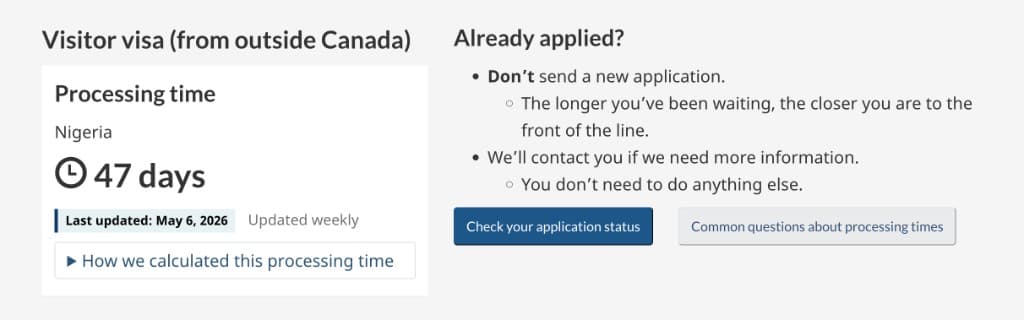
Convocation is September 2026. The IRCC processing-time tool reports 47 days for Nigerian visitor visa applications from outside Canada (last updated by IRCC on May 6, 2026; updated weekly). GCMS notes add 30–90 days on top of that. Working backwards from a mid-September convocation, with a 2–3 week buffer for biometrics and possible document requests, the next reapplication should be filed by mid-June 2026 at the latest — end of May or first week of June is safer.
Cover letter that answers each past refusal (excerpt)
One to two pages, narrative, three short paragraphs that answer the prior decisions, and the supporting documents listed at the end of the letter — not cited inline throughout the body. Officers read dozens of files a day; a clean narrative wins them over faster than a cover letter peppered with filenames. The full file is curated rather than padded — every document earns its place by answering one of the prior officer concerns.
Re: Temporary Resident Visa (visitor) — [Sister's full name as in passport]
UCI: [if known]    Application: [reference]    Prior refusals: 3 (May 2025, [Q] 2026, [Q] 2026)

Dear Visa Officer,

I write in support of my sister's application to attend my university convocation in [city, Canada] on [convocation date]. The trip is ten days; her return-to-business date in [Nigerian city] is [return date]. The three prior decisions on this file each centred on (i) purpose of visit and (ii) source of funds. Each concern is addressed in the three short paragraphs below. A complete list of supporting documents — in the order they appear in the upload — is set out at the end of this letter.

Purpose of visit. Convocation is a fixed, third-party-verifiable event. A letter from the University Registrar confirms my program, conferral date, and convocation date. My sister has the convocation guest invitation, a day-by-day itinerary that brackets convocation by no more than five days on either side, and a refundable return flight matching the itinerary end date. There is no flexibility in the trip dates: she arrives the day before convocation week opens and departs the day after the family events close.

Source of funds and business income. My sister operates [business name], registered with the Corporate Affairs Commission since [year]. The application is supported by two years of FIRS tax filings, twenty-four months of business bank statements on bank letterhead with full transaction history (not screenshots), a chartered accountant's letter dated within thirty days, and an annotated invoice pack matching each of the five largest deposits in the statements to a named customer and invoice number. The funds are documented as my sister's own and the deposit pattern is consistent across the twenty-four-month window.

Departure intent. My sister's ties to Nigeria are concentrated in three places: an active business with twenty-four months of revenue history, registered property in her name, and a dependent [parent/relative] she supports and visits regularly. A one-page ties matrix summarising these is included at the end of the file. The trip is ten days, the return date is fixed by the business calendar, and she has every commercial and personal reason to come home on time.

This file has been curated, not padded. I have included only the items that directly respond to the prior decisions. Should you require any further specific evidence, I would be glad to provide it on request.

Sincerely,
[Sister's name]

Documents enclosed (upload order):
ex_01_cover_letter.pdf
ex_02_passport_bio_and_stamps.pdf
ex_03_prior_refusals_and_gcms_notes.pdf
ex_04_host_invitation_letter.pdf
ex_05_host_status_documents.pdf
ex_06_university_registrar_letter.pdf
ex_07_convocation_guest_invitation.pdf
ex_08_itinerary.pdf
ex_09_return_flight_reservation.pdf
ex_10_business_letter_sister.pdf
ex_11_cac_business_registration.pdf
ex_12_firs_tax_filing_2024.pdf
ex_13_firs_tax_filing_2025.pdf
ex_14_business_bank_statements_24mo.pdf
ex_15_personal_bank_statements_6mo.pdf
ex_16_chartered_accountant_letter.pdf
ex_17_invoice_pack_top5_deposits.pdf
ex_18_property_deed.pdf
ex_19_dependants_documents.pdf
ex_20_ties_matrix.pdf
Twenty PDFs, in the order we upload them
The checklist goes first. The PDF name is the handle — when the cover letter cites ex_06_university_registrar_letter.pdf, the officer sees that exact filename in the upload folder. No guessing which “Document 6” meant. Upload in this order.
| Filename | Document | Why it matters |
|---|---|---|
| ex_01_cover_letter.pdf | Cover letter (answers each past refusal) | Walks point-by-point from the refusal notes to the matching PDFs. |
| ex_02_passport_bio_and_stamps.pdf | Sister's passport bio + every stamped page | Identity and travel history baseline. |
| ex_03_prior_refusals_and_gcms_notes.pdf | Prior refusal letters (3) and GCMS notes | Acknowledged and answered in ex_01. |
| ex_04_host_invitation_letter.pdf | Host's invitation letter (dated, signed) | Specific dates, address, relationship, host's commitments. |
| ex_05_host_status_documents.pdf | Host's status documents (study/PGWP/PR/citizenship) | Host is a credible Canadian inviter. |
| ex_06_university_registrar_letter.pdf | University registrar letter — program + convocation date | Trip is bound to a fixed, third-party verified event. |
| ex_07_convocation_guest_invitation.pdf | Convocation guest invitation / ticket | Sister has a verifiable seat at the event. |
| ex_08_itinerary.pdf | Day-by-day itinerary | 10 days in Canada, dates bracket convocation by ±5 days. |
| ex_09_return_flight_reservation.pdf | Refundable return flight reservation | Exit date matches itinerary and return-to-business date. |
| ex_10_business_letter_sister.pdf | Sister's employment / business letter | Stated role, gross income range, return-to-business date. |
| ex_11_cac_business_registration.pdf | CAC business registration certificate | Business legally exists in Nigeria in sister's name. |
| ex_12_firs_tax_filing_2024.pdf | FIRS tax filing — 2024 | Reported income to Nigerian tax authority — first year. |
| ex_13_firs_tax_filing_2025.pdf | FIRS tax filing — 2025 | Reported income to Nigerian tax authority — second year. |
| ex_14_business_bank_statements_24mo.pdf | Business bank statements — 24 months on letterhead | Organic deposit pattern; lumpy SME income explained over 24 months instead of 6. |
| ex_15_personal_bank_statements_6mo.pdf | Personal bank statements — 6 months on letterhead | Living expense pattern matching the business income. |
| ex_16_chartered_accountant_letter.pdf | Chartered accountant letter (signed, dated within 30 days) | Third-party letter on revenue, profit, and taxes filed. |
| ex_17_invoice_pack_top5_deposits.pdf | Invoice pack — top 5 deposits annotated | Each large deposit traced to a named customer and invoice. |
| ex_18_property_deed.pdf | Property deed or long-term lease in sister's name | Anchored asset in Nigeria. |
| ex_19_dependants_documents.pdf | Dependants documents (parent/child IDs + remittance history) | Care responsibilities tying sister to home. |
| ex_20_ties_matrix.pdf | Ties matrix (one page) | One-page snapshot of ties to Nigeria with pointers to each PDF. |
One-page ties snapshot for Nigeria
| Category | Evidence | PDF filenames |
|---|---|---|
| Business | CAC registration + FIRS filings + 24 months bank statements + accountant letter |
|
| Customer base | Top 5 invoices matching top 5 deposits — named customers |
|
| Property | Title deed or registered long-term lease in sister's name |
|
| Dependants | Parent / child ID + remittance history + sister's role in care |
|
| Trip binding | Registrar letter + convocation invitation + 10-day itinerary + return flight |
|
The source-of-funds rebuild for a Nigerian SME
This is the load-bearing part of a new application. Nail the money trail and the visitor test under IRPR 179 — especially 179(b) (going home) with means tied to 179(d) — gets much easier to argue; phone it in and a fourth refusal is the default.
- Twenty-four months of business bank statements on bank letterhead (not PDFs from internet banking, not screenshots).
- CAC business registration certificate and any sector compliance certificates.
- FIRS tax filings for the last two years; if the business is below the VAT threshold, attach the personal tax return covering business income instead.
- Customer invoices matching at least the five largest deposits over the 24-month window — same amounts, same dates.
- A signed letter from a chartered accountant on letterhead summarising gross revenue, net income, and taxes filed (dated within 30 days of submission).
- Personal bank statements covering 6 months that show ordinary living expenses flowing out — to demonstrate the funds are real and used.
- If any deposit comes from a loan, sale of property, or family transfer: an annotated note in the cover letter and the underlying document (loan agreement, sale receipt, transfer reference).
Paperwork that pins the trip to convocation
- Registrar-issued letter from the host's university stating the host's program, expected conferral date, and convocation date — university letterhead, signed.
- The convocation guest invitation or ticket — guest allocation varies by university; confirm with the registrar.
- Host's current status document in Canada (study permit + counterfoil, PGWP, PR card, or citizenship certificate). Avoid hosts who have been in status less than 6 months where possible.
- Day-by-day itinerary bracketing the convocation date by no more than 10–14 days. Officers refuse open-ended “September 2026” trips; they approve “September 18 to 27, 2026.”
- Refundable or hold return flight matching the itinerary end date.
- A short paragraph in the cover letter explaining the host's relationship to the applicant, the host's status, and the post-event return path.
Do — for sibling-to-graduation reapplications
Curate the file. List supporting documents at the end of the cover letter, not inline throughout.
Officers are reading dozens of files a day. A 1–2 page narrative cover letter with the document list at the bottom reads cleanly; a body cluttered with filename citations slows them down and gives the eye more places to find an inconsistency. Every exhibit should earn its place by answering a prior officer concern — if it doesn't, leave it out.
Address each prior refusal concern directly in the cover letter narrative.
It signals to the next officer that you read the prior decisions and rebuilt the file around them — not that you ignored them. You can reference concerns by topic (purpose / funds / departure) rather than copy-pasting the boilerplate sentence.
Lead with source-of-funds, not ties.
The officer's note tells you where the file failed. Funds is the weight-bearing wall. Fix it first; ties second.
Use 24 months of business statements, not 6.
Nigerian SMEs deposit lumpily. Six months can hide a single contract; 24 months shows pattern.
Annotate the top five deposits with named customers and matching invoices.
Officers do not need every deposit explained — they need the pattern proved. Five matched deposits prove a real business.
Tie the trip to the convocation date with a registrar-issued letter, not just an invitation from the host.
An invitation from the brother is not third-party verifiable. A registrar letter is.
Bracket the trip to ±5 days around the convocation.
Short, specific trips read as honest. Long, open-ended trips read as immigration risk.
Don't — what kills attempt four
Don't dump every document you have into the file.
More paper is not stronger evidence. Each extra document is one more place for a date mismatch, a balance discrepancy, or a name spelling difference to surface. Curate to answer the prior officer concerns; leave the rest out unless asked.
Don't cite filenames inline throughout the cover letter body.
It overwhelms the officer and makes the letter read like a database query. Tell the story in the body; list the documents at the end. The officer will check the list when they want to verify a claim.
Don't reapply with the same package and a slightly reworded cover letter.
Three refusals on the same file means the next officer is anchored. Substantive change or stay refused.
Don't add a bigger bank balance.
The officer didn't refuse for low funds — they refused for unexplained funds. A bigger unexplained balance makes the problem worse.
Don't book non-refundable flights or hotels before approval.
It does not pressure the officer and it costs money on a fourth refusal.
Don't use a generic invitation letter.
Every line that is not specific (names, addresses, dates, university, program) reads as immigration risk on attempt four.
Don't fight the prior refusals on Federal Court grounds without counsel.
JR is a narrow remedy. The pragmatic path here is reapplication with a substantively rebuilt file, not litigation.
How long will the visitor visa take from Nigeria — and how to check the live number
Last updated by IRCC: May 6, 2026 · Updated weekly
IRCC publishes the live country-specific estimate in its processing-time tool. The 47-day figure above is what the tool displayed on May 6, 2026 for new visitor visa applications submitted from outside Canada by Nigerian applicants. The number is the only figure IRCC will commit to and it changes weekly — pull it again before every planning decision.
How to check today's Nigeria visitor visa processing time
- Step 1Open the IRCC processing-time tool: canada.ca/…/check-processing-times.html. Under Select an application type, choose Temporary residence (visiting, studying, working).
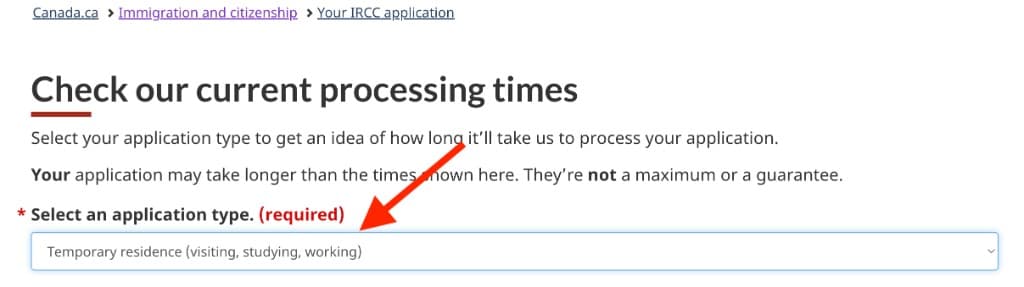
Step 1: On the IRCC processing times page, open the “Select an application type” dropdown and choose Temporary residence (visiting, studying, working). - Step 2A second dropdown appears. Choose Visitor visa (from outside Canada).
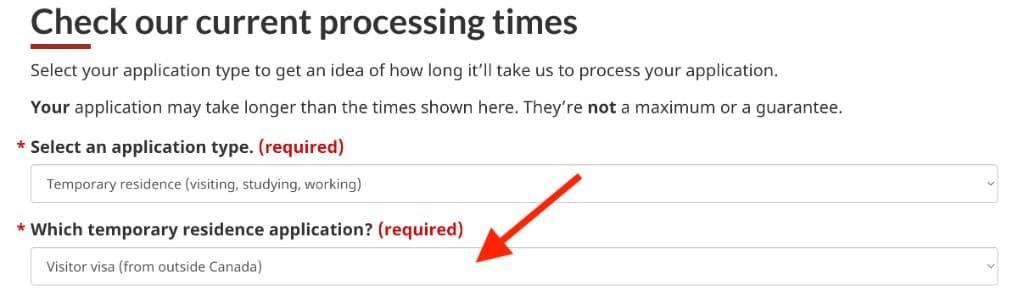
Step 2: From the “Which temporary residence application?” dropdown, select Visitor visa (from outside Canada). - Step 3Select Nigeria from the Where are you applying from? dropdown, then click Get processing time.
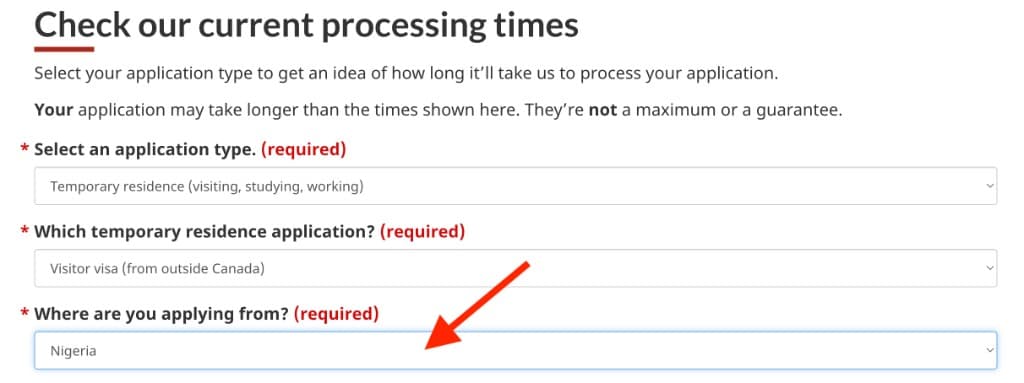
Step 3: Choose Nigeria from the “Where are you applying from?” dropdown, then click Get processing time to see the current Canada visitor visa processing time for Nigerian applicants. - Step 4The tool shows the current estimate — as of May 2026, that's 47 days for Nigeria. Screenshot the result and date-stamp it for your file. Re-check weekly and again on submission day so your cover letter reflects the figure IRCC was publishing when you filed.
How to plan backwards from a September 2026 convocation
Take the live 47-day figure and add a buffer. Two real risks eat the buffer: biometrics scheduling at the local VAC after the application is in process, and additional document requests from the visa office. The math from a mid-September convocation:
| Anchor | Date | Why |
|---|---|---|
| Convocation | Mid-September 2026 (illustrative — Sep 15) | The fixed event the trip is bound to. |
| Visa needed in hand | ≈ 3 weeks before convocation (≈ Aug 25, 2026) | Time to receive the passport from VAC, book non-refundable flights, and clear the convocation week. |
| Latest acceptable submission | ≈ June 19, 2026 (Aug 25 minus 47 days minus ~2-week buffer) | Live IRCC figure of 47 days plus a buffer for biometrics, document requests, and country variability. |
| Earlier-is-safer submission | End of May / first week of June 2026 | Buys ~3 extra weeks of cushion if the published figure shifts up while in process. |
The dates above use the live IRCC figure of 47 days last published on May 6, 2026. Pull the live figure from the IRCC tool the day you plan and re-run the math — the figure refreshes weekly. If the published number jumps above 70 days while you are mid-build, file as soon as the source-of-funds rebuild is complete rather than waiting for more polish — the binding constraint becomes the calendar, not the cover letter.
Step-by-step: how to file attempt four with the convocation in September
Five steps over roughly 60–75 days, working backward from a September 2026 convocation date. Adjust if your convocation is earlier; if your convocation is later, build in buffer for processing variance.
| Step | When | What to do |
|---|---|---|
| 01 | Day 1–3 | Pull the third refusal letter and order the GCMS notes for all three refusals through the Government of Canada ATIP portal. CAD $5 each. A Canadian citizen, PR, or any individual present in Canada can file with the sister's written consent. |
| 02 | Day 4–14 | Start the source-of-funds rebuild while the notes process. Pull 24 months of business bank statements on letterhead, the CAC certificate, last two FIRS filings, and ask a chartered accountant for a signed income letter dated within 30 days of the planned submission. |
| 03 | Day 15–30 | Email the host's university registrar to request a letter naming the host's program, conferral date, and September 2026 convocation date. Confirm guest ticket allocation. Build a 10-day itinerary bracketing the convocation by ±5 days. |
| 04 | Day 30–60 | GCMS notes typically arrive in this window. Read each note's final line — that is the sentence to quote and answer in the new cover letter. Cross-check every date and dollar figure across forms, invitation, itinerary, and bank statements. |
| 05 | Day 60–75 | Assemble the 20 PDFs in IRCC online portal upload order with clean filenames — use the same names as in the checklist (`ex_01_cover_letter.pdf`, `ex_02_passport_bio_and_stamps.pdf`, `ex_06_university_registrar_letter.pdf`, …). Run an “if I were the officer” pass against the checklist. Submit through the IRCC Secure Account. |
Paste your refusal letter. Get a ranked analysis of why IRCC refused you and what you must fix.
Paste your refusal letter and GCMS notes into the Immigration DM assistant. Walk through a short intake. The free preview spells out the key issues. The $69 CAD analysis delivers the ranked plan:
- Ranked list of the refusal reasons from your letter.
- What the officer needs to see for each reason.
- The documents you must prepare this week.
- 1–2 page personalized analysis. $69 CAD. One-time. No subscription.
Frequently asked questions
I've applied 3 times for my sister's Canada visitor visa for my graduation and they keep denying it. What now?
Stop reapplying with the same file. Three refusals on the same evidence anchors the next officer toward a fourth refusal. Order the GCMS notes for each prior refusal under ATIP for CAD $5 each, identify the through-line (in this kind of case, almost always source of funds and purpose of visit), and rebuild two specific things: (1) a 24-month business audit trail with CAC registration, FIRS filings, customer invoices, and a chartered accountant letter; and (2) a registrar-issued graduation document with a 10-day itinerary tied to the convocation date.
Why does IRCC keep refusing visitor visas from Nigeria for graduation visits?
Two patterns dominate. First, Nigerian source-of-funds files often show a healthy bank balance with no audit trail — IRCC officers treat unexplained funds as not credibly the applicant's. Second, graduation invitations are often written informally by the host (the graduating student) without a registrar-issued letter naming the conferral and convocation date. Together, these create a file the officer cannot bind to a specific, time-bound, verifiable event with credible funds — which commonly supports a refusal under IRPR 179(b) (departure) and can engage 179(d) (visitor class). Nigeria has run in the higher-refusal band per IRCC Open Data, which raises the documentary bar.
What does the GCMS officer note actually mean when it says 'source of funds'?
It means the officer can see the balance but cannot see how it got there. Visa officers treat unexplained large deposits as weak proof of means for the trip; that feeds the overall examination under IRPR 179 — often expressed as 179(b) (will depart) in the refusal letter even though the note quotes sufficient-funds language. The fix is an audit trail: 24 months of business bank statements, tax filings, customer invoices matching the top deposits, and a chartered accountant letter.
Is a graduation invitation from my Canadian university the same as the host's letter?
No, and this is the document gap that breaks most graduation files. The host's invitation letter is written by the graduating student and is not third-party verifiable. The university registrar letter is on letterhead, names the host's program, and confirms both the conferral date and the convocation date. The convocation guest ticket — guest caps vary by school, so confirm with the registrar — is the additional anchor that says the visiting sibling has a confirmed seat at the event. File both, plus a 10-day itinerary bracketing the convocation.
How many months of bank statements should a self-employed Nigerian applicant submit for a Canada visitor visa?
Twenty-four months of business bank statements on bank letterhead, not internet-banking PDFs. Six months is the default IRCC asks for, but Nigerian SMEs deposit lumpily — six months can hide a single contract that distorts the pattern. Twenty-four months shows the deposit pattern over time, supports the FIRS tax filings, and lets the officer see ordinary withdrawals matching ordinary business expenses. Pair the statements with a chartered accountant letter and a top-5-deposit annotation pack.
Should I wait until I have GCMS notes for all three refusals before reapplying?
If your graduation is not until September 2026, yes. The notes typically take 30–90 days each in 2026 and they tell you exactly what each officer wrote. If time is tight, file the ATIP for the most recent refusal first — that note carries the most weight because it is the most current — and start rebuilding while it processes. Reapplying without any GCMS notes after three refusals is guessing, and a fourth refusal on guesswork compounds the record.
Will my sister be banned from Canada after multiple refusals?
A standard temporary resident visa refusal under IRPR 179 does not ban anyone from Canada — there is no statutory cooling-off period and no automatic bar. What changes is that each refusal is part of her permanent IRCC record and visible to every future officer (TRV, study, work, or PR). A misrepresentation finding under IRPA section 40 is different — that carries five years of inadmissibility from the final determination. None of the three refusals in this case mention misrepresentation; the GCMS note here culminates in IRPR 179(b) (departure), with purpose and funds supporting that conclusion.
What does Immigration DM actually put together for a situation like this?
For this application, Immigration DM outputs a 1–2 page ranked analysis: why IRCC said no under IRPR 179 (especially 179(b) departure, with funds and trip purpose feeding 179(d)), what the officer needs to see, the evidence to prepare, and actions for this week. The free preview covers the key issues. The $69 CAD analysis is the full ranked plan. A cover letter and portal checklist are a later add-on.
Should I hire an RCIC or lawyer at this point?
Three refusals is the inflection point where many applicants benefit from involving a Regulated Canadian Immigration Consultant (RCIC) or immigration lawyer — particularly if any of the prior notes hint at credibility concerns or if the source-of-funds rebuild requires Nigerian counsel to coordinate CAC and FIRS records. The reapplication itself is still the pragmatic path; the question is whether you build the file alone or with help. Federal Court judicial review is rarely the right tool for a visitor refusal framed primarily on IRPR 179(b) with a similar fact pattern.
How long does a Canada visitor visa take from Nigeria as of May 2026?
As of May 9, 2026, the IRCC processing-time tool reports 47 days for visitor visa applications submitted from outside Canada by Nigerian applicants — the figure last updated by IRCC on May 6, 2026 and refreshed weekly. Always pull the live number before planning: open the IRCC processing-time tool on canada.ca, choose Visit → Visitor visa (from outside Canada), and select Nigeria. Screenshot the result the day you plan, and re-check on submission day. Build at least 2–3 weeks of buffer on top of the published figure for biometrics scheduling at the local VAC and any document requests from the visa office, plus another 30–90 days if you are still waiting on GCMS notes for prior refusals.
What if the convocation has already passed by the time my sister gets approved?
It happens, especially after multiple refusals. Two practical options: (1) some Canadian universities hold the diploma for in-person conferral at a later session, or offer a deferred convocation — ask the registrar; (2) reframe the trip around a post-graduation family visit and the host's PGWP-stage life rather than the convocation event itself, with new specific dates and itinerary. Do not reuse the same purpose-of-visit cover letter after the convocation date passes.
Official links we used
Canada.ca and the justice laws site, plus IRCC help pages and open data, and Nigerian CAC / FIRS — the same places we point to in the article.
- Immigration and Refugee Protection Act — section 11 (visa after examination)
- Immigration and Refugee Protection Regulations — section 179 (temporary resident visa)
- Canada.ca (IRCC) — Understand your visitor visa application refusal
- IRCC Help Centre — My application for a visitor visa was refused. Should I apply again?
- IRCC Help Centre — Who can make a request under the Access to Information Act?
- IRCC Open Data — Temporary Resident Visa applications and outcomes
- IRCC — Check application processing times (live tool, updated weekly)
- Corporate Affairs Commission (CAC) Nigeria — search and verify business registration
- Federal Inland Revenue Service (FIRS) Nigeria — taxpayer services
Real application; we removed the applicant's name, file numbers, and anything identifying. The officer note matches GCMS wording aside from those edits. Immigration DM samples on this page come from the pack built for this refusal. Placeholders in square brackets are filled from your intake. This is general information, not legal advice. Every visitor visa is different — after several refusals, an RCIC or immigration lawyer is often worth a call.